

October 28th-November 3rd // Estimated Reading Time: 12 minutes
Below is a roundup of last week’s notable industry news, with summaries and our opinions. It’s mergers and acquisitions season!

You’ve bought AI tools. You’ve built AI products. But your team sounds and acts the same, and the revenue needle isn’t moving. You need to:
a) Build an AI playbook that everyone can use…
b) Enable your entire team on the playbook…
In order to create real, significant business impact.
Leveling up your team on AI is the biggest growth lever you can pull in 2027. Don’t take it from us, take it from BCG. We can help. Let’s chat!


Top Headlines 👀
DoorDash acquires Instacart as consolidation comes for mobility media - DoorDash is paying $17B for Instacart. Instacart will keep its name and its app. The two apps serve different needs: Instacart for the big weekly grocery run and DoorDash for quick food delivery. In Q3, DoorDash processed $33.9B in orders, compared to $10.5B for Instacart. Both companies have billion-dollar ad businesses; DoorDash passed $1B in ad revenue in 2024, and Instacart made more than $300M from ads in Q3 alone. Uber had also been in talks to acquire Instacart. Experts warn the deal could raise prices for consumers and leave grocers with fewer delivery partners. Opinions are mixed on how much antitrust scrutiny the deal will get. If regulators and shareholders give it the green light, the deal may close in late 2027 or early 2028.
Opinion: From an ad perspective, DoorDash + Instacart would become a retail media behemoth overnight. Third place behind Amazon (~$75B) and Walmart (~$7B), and bigger than Uber Advertising (~$2B) and Target Roundel (~$2B).
The combined entity would be quite comprehensive and complementary:
Instacart would bring: Carrot Ads (onsite retail media tech for grocers), Storefront (e-commerce and fulfillment tech for grocers), Caper Carts (in-store ad inventory), and offsite data deals with TTD, Roku, Google, and Meta.
DoorDash would bring: Symbiosys (offsite retail media tech), and international reach through Wolt and Deliveroo.
Together, that’s an end-to-end “food” tech stack: e-commerce tech, onsite and offsite ad tech, two robust ad marketplaces, and in-store ads. Also, a single company would see what a household gets delivered for both groceries and takeout. For marketers, one vendor covering ~77% of US delivery app spending would be quite convenient! We see the vision…

Walmart opens shopper audiences to advertisers on its CTV platform, Vibe🔒 - Advertisers on Vibe can target more than 3,300 audience segments built from Walmart’s first-party online and in-store shopping data. This is the first major offering to come out of Walmart's $1.4B acquisition of Vibe, a CTV buying platform built for small and midsize businesses. Advertisers can target recent buyers or shoppers likely to buy soon, and they can mix in their own customer data. No contract is required. One catch: They can’t use Walmart’s data for tying ads to actual Walmart purchases yet. Instead, they’ll rely on Vibe’s own tools and measurement partners like Northbeam, Triple Whale, and Haus for now.
Opinion: The promise of Walmart + Vibe was to bring Walmart shopper data to the mid-tail and long-tail, who Walmart doesn’t work with today, in order to open up a new source of ad revenue. So … it’s happening. Perhaps earlier than anticipated.
Shopper data is becoming the key battleground for long- and mid-tail CTV dollars. Amazon has its DSP, Pinterest has tvScientific, and Walmart has Vibe plus Vizio. That leaves independents like MNTN and JamLoop competing on tech and creative. We can expect these companies to get snatched up by data-rich acquirers, too. (DoorDash, perhaps?!)
Affle acquires Perion for $420 million, because 'synergies' - Affle is an India-based mobile ad tech company focused on performance marketing, mostly in emerging markets. Tel Aviv-based Perion sells CTV, digital out-of-home (DOOH), and retail media ads, mostly to big brands and agencies in North America. Since 2023, Perion has bought Hivestack for $100M, Greenbids for $65M, and PRN, an in-store retail media company, for $12M. Perion acquired rich media ad network Undertone for $180M in 2015. Perion CEO Tal Jacobson said the company never had strong mobile performance tech. Affle fills that gap, and in return it gets Perion’s relationships with large American agencies and brands. Jacobson will stay on as CEO, and the all-cash deal should close in early 2027.
Opinion: A profitable ad tech company out of India picking up a sub-scale US/Israeli ad tech roll-up at a modest price is a bit surprising. Perion has spent years (and hundreds of millions of dollars) acquiring its way into a holistic ad offering. Only to get bought by a point solution in a smaller market. It’s all about scale and profitability in the current environment. There will be more of these deals. Sub-scale public ad tech companies with beaten-down valuations are easy targets for profitable buyers from outside the US.

AI ad-placement companies Rembrand and Whisper World merge, eye IPO🔒 - Both companies dynamically insert brands into TV shows and movies. The format has been hard to buy at scale because every placement required negotiation with multiple parties. Whisper World solved that initially by selling virtual billboards as 15-second units measured in gross rating points (GRPs, the standard TV metric for reach). Founded in 2013, Whisper World has worked across Asia, Africa, and the Middle East, using more than 100 visual effects artists who edit scenes by hand. Rembrand brings AI that can handle far more of that work without new headcount, plus partnerships with Paramount and Hallmark that help Whisper World enter the US market. Through the merger, Rembrand grows about fourfold and gains years of premium TV footage to train its AI. The combined company, WRLabs, will work with about 3K advertisers and reach over 2B viewers a month. They plan to raise money after the deal closes in January.
Opinion: Well that didn’t take long! Another buyer from outside the US picks up an American ad tech roll up (Rembrand merged with Spaceback last year). This time in creative tech. Scale and profitability are the name of the game!
Publicis closes $2.2B LiveRamp deal, betting 'neutral' tech can still be a competitive advantage - Now that the deal has closed six months after it was first announced, Publicis execs are explaining how they can profit from LiveRamp while keeping it neutral. Publicis CEO Arthur Sadoun said the payoff will come from pairing LiveRamp with Epsilon, the identity company Publicis bought for $4.4B in 2019. The first product, a so-called “plug-and-play AI growth engine,” combines LiveRamp and Epsilon so marketers can enrich their own customer data and use it across 25K publishers and 500 tech and data partners. Publicis says the tool will help advertisers keep control of their data and avoid paying consultants to build costly custom systems. Despite FTC rules requiring Publicis to give rivals equal access to LiveRamp and stay out of their data, WPP has stopped using LiveRamp and Omnicom plans to exit.
Opinion: We’ve said this before, we’ll say it again. Publicis is not dumb. It did not acquire LiveRamp with the illusion that it will be able to keep customers from rival holdcos. It acquired LiveRamp to steal accounts from rival holdcos using LiveRamp as a core part of its pitch, and juice its principal-based media buying practice. Aside from identity and data, guess what else Epsilon sells? Media. It all checks out…
Check out the most recent AI Edge Podcast episode with LiveRamp’s Chief Connectivity & Ecosystem Officer, Travis Clinger.

Q3 Earnings!
Alphabet (👎): Revenue was up 25% to $127.58B, missing estimates. Ad revenue was up 10.6% to $82.01B. Search revenue was up 12% to $63.35B, missing estimates. YouTube ad revenue was up 9% to $11.21B. Cloud was a major bright spot, up 103% to $30.7B due to AI-driven demand. Free cash flow was -$9.07B. AI spending will hit $195B-$205B this year and much more in 2027. Shares fell about 10% after hours.
Microsoft (👍): Revenue was up 19% to $92.28B, beating estimates. Azure revenue was up 48% to $33.17B. Search and ad revenue was up 12%. Current quarter revenue guidance topped estimates. 2027 AI spending will hit $170B. Shares rose 4% after hours.
Amazon (👎): Revenue was up 12% to $201.94B, missing estimates. Ad revenue was up 11% to $19.64B, also a miss. Current quarter guidance missed. 2026 AI spending will hit $220B and climb “meaningfully” in 2027. Shares fell 6% after hours.
Reddit (👎): Revenue was up 53% to $895M, beating estimates. Ad revenue was up 54% to $847M. Daily active users were up 12% to 130.3M, missing estimates, as AI search cut Google referral traffic. Current quarter guidance missed. Shares fell more than 15% after hours.
Pinterest (👎): Revenue was up 12% to $1.17B, missing estimates. European regulatory changes cut growth by 3 percentage points and will hurt Q4. Monthly active users were up 10% to a record 661M. Current quarter guidance missed. Shares fell more than 10% after hours.
Roku (👍): Revenue was up 24% to $1.5B, beating estimates. Ad revenue was up 23% to $727M, driven by political ad spend and strong media and entertainment ad growth. Roku didn’t issue guidance because of its pending $22B acquisition by Fox. Shares were flat after hours.
Apple (👎): Revenue was up 12% to $114.48B, beating estimates. iPhone revenue was up 17%. Services revenue, which includes ads, grew 9.8% to $31.6B, its slowest growth since 2022. Current quarter revenue guidance topped estimates, but the margin forecast missed. Shares fell 3% after hours.
Fox (👍): Revenue was up 22% to $4.57B, beating estimates. Ad revenue was up 47% to $2.08B, driven by the World Cup, political ads, and Tubi. The midterms delivered about $350M in political ad revenue this cycle. Shares rose more than 5% premarket.
People Inc. (👎): Revenue was down 4% to $430.8M, missing estimates. Ad revenue fell 8% to $162M as AI search has cut Google traffic 70% over the last two years. Licensing revenue, including AI deals, rose 49%. People cut 6% of staff last week. Shares fell 4% after hours.
Shopify (👎): Revenue was up 32% to $3.74B, beating estimates. The total value of goods sold through Shopify was up 29% to $119.2B, missing estimates, as did subscription revenue. Shares closed 9% lower.
DoubleVerify (👍): Revenue was up 9% to $205.6M, driven by social and CTV spend. DV issued no guidance because of its pending $13.60-a-share sale to Nielsen. Shares remained flat.
Stagwell (👍): Organic net revenue was up 7.4% to $664M, driven by 23% growth in digital transformation and 108% growth in its Marketing Cloud software unit. The media business declined 2.1%. Stagwell raised its full-year profit guidance. Shares rose 3% premarket.
WPP (👍): Organic revenue was down 2.1%, an improvement from Q2. WPP Media grew 0.3%, its first growth quarter in two years, while creative fell 5.1%. WPP reiterated guidance and expects to return to growth in 2027. Shares rose 2.5%.
Opinion: It’s not a good time to be an ad company. Companies that are heavily dependent on ad revenue (Google, Meta, Amazon) and are simultaneously spending a lot of money on AI, are getting hosed by investors, even if they have AI infrastructure plays (like Google Cloud and AWS). We are moving these companies into the AI “burners” category for now. The AI “earners”, companies that primarily sell AI infrastructure and software (like Microsoft) are still doing alright.
The big story here is the slowdown in Google’s search revenue. Google has done a great job of diversifying its revenue across new businesses, like YouTube, Cloud, etc. In fact, this is the first quarter in Google’s history that Search revenue dipped below 50% of total revenue!
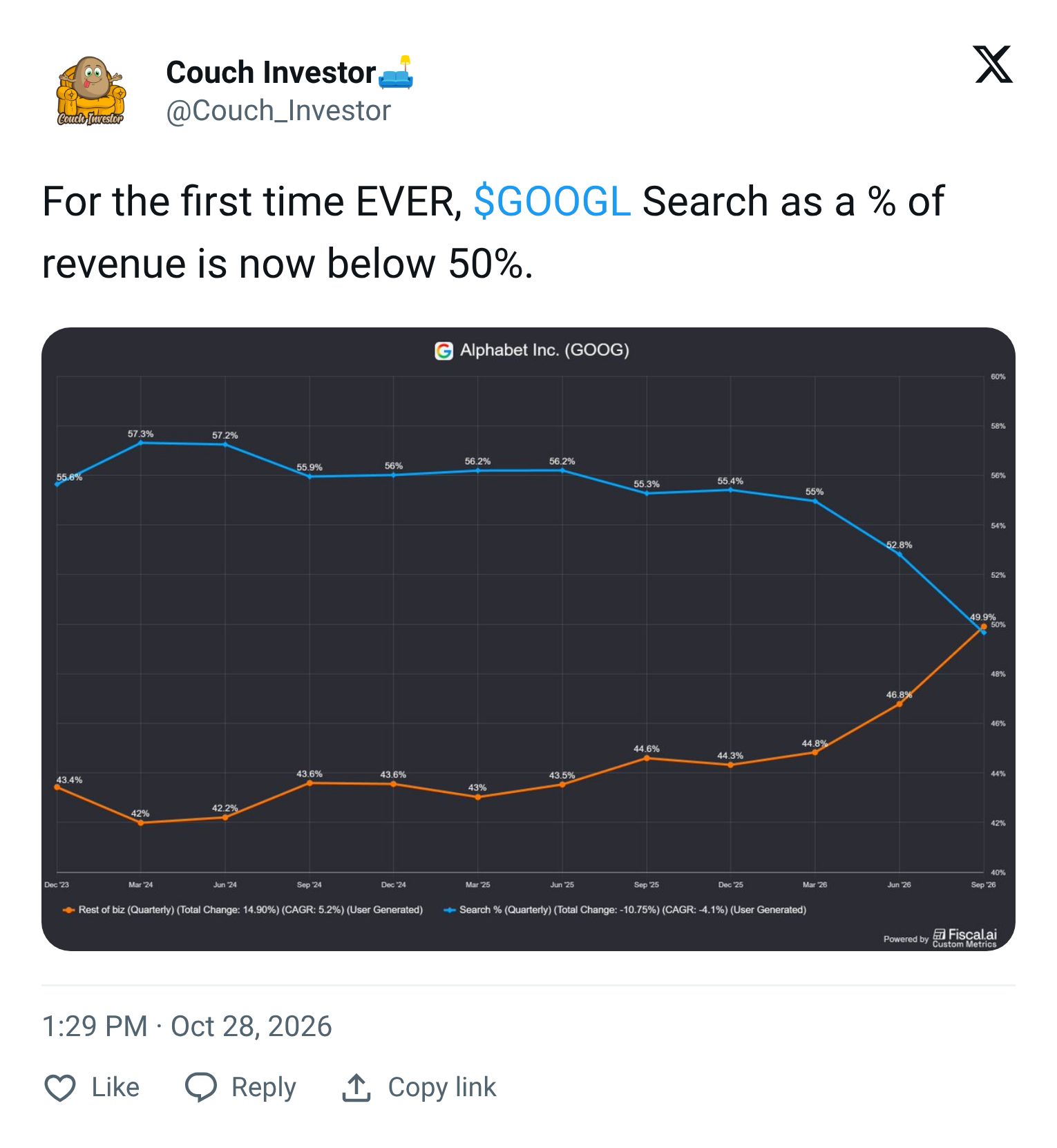
Good on Google, it was diversify or die. Regardless … this is not a good sign for Google. Google has always dominated traditional search, so search advertising has always been Google’s cash cow. But the search advertising cash cow has stopped getting fatter because of AI search (ChatGPT claims it has reached 1.2B users, and 20% of Google’s search volume). Sure, Google is a formidable player in AI search, but its position isn’t dominant. There’s no guarantee it ever will be. Where will Google be able to reestablish itself as the dominant player?
Other Notable Headlines 🤓
Obit: Droga5 CEO Mark Green dies at 53 - Green died unexpectedly of a heart attack in New York on Saturday. He previously co-founded The Monkeys, an Australian agency that Accenture Song bought in 2017.
As political ad spending skyrockets, broadcast TV remains king🔒 - AdImpact projects a record $11.6B in midterm political ad spend, with broadcast TV taking the biggest share at 48% ($5.6B).
The Trade Desk brings back Dave Pickles amid growing pains🔒 - The Trade Desk’s co-founder, Dave Pickles, stepped down as chief technology officer (CTO) in 2023. He is returning and will now lead a new CTO Council guiding TTD’s tech roadmap.
MrBeast appoints Michelle St. Jacques as first CMO of Beast Industries - St. Jacques has run the company’s consumer goods business since February and will keep that role. She was previously CMO and chief commercial officer at Molson Coors, and before that held marketing leadership roles at Kraft Heinz.
Reddit moves to logged-in experience as AI eats search - Reddit says logged-in users engage about 5x more and are easier to target with ads. The change will make it harder for AI bots to scrape Reddit's content without paying.

That’s It For This Week 👋
The U of Digital Weekly Newsletter is intended for subscribers, but occasional forwarding is okay!
To subscribe visit Uof.Digital/Newsletters or contact us directly for group subscriptions.
And remember, U of Digital helps teams drive better outcomes through structured education on critical topics like AI, programmatic, CTV, commerce media, and much more. Interested in learning more about how we can supercharge your team? Drop us a line!
Thanks for reading!
